
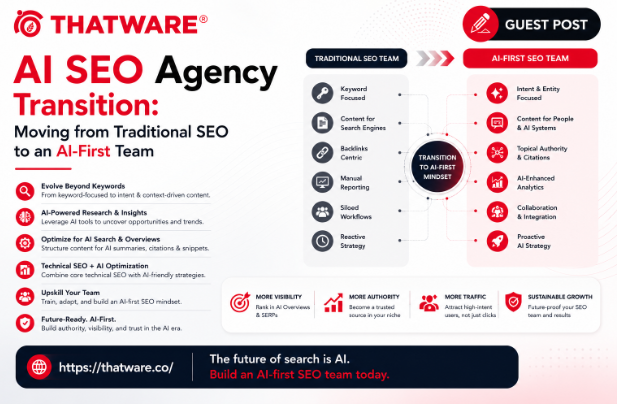
Switching SEO agencies is never a fun process. There’s the awkward offboarding conversation, the inevitable period of transition anxiety when rankings feel fragile, the ramp-up time before the new team actually understands your site. Nobody likes it. Most brands stay with mediocre agencies longer than they should simply because the switching cost feels high.
But there’s a particular version of this switch that’s happening a lot in 2025 and 2026 — and it’s more complex than a standard agency change. It’s the transition from a traditional SEO firm to one operating with genuine AI-first methodology. And the complexity isn’t just logistical. It’s philosophical.
Here’s what that transition actually looks like, and what you need to think about before you make the move.
The Traditional SEO Model and Why It’s Running Out of Steam
To understand why the transition is happening, it’s worth being honest about what traditional SEO has been and where its limits are showing.
Traditional SEO, in its mature form, is a process-driven discipline. You audit the site, identify technical issues, build content around keyword targets, acquire backlinks, monitor rankings. Repeat. Good agencies do this competently. The processes are well-understood, the metrics are clear, and the improvement trajectory — while slow — is predictable.
The problem is that this model was designed for a more static version of search. Keyword rankings were relatively stable signals. Algorithm updates were significant but infrequent. The relationship between inputs (content, links) and outputs (rankings, traffic) was reasonably linear.
The search landscape of 2025-2026 is different in ways that break the traditional model. AI-generated overviews have changed how users interact with results. Entity-based ranking means topical authority matters in ways keyword targeting alone doesn’t capture. Search intent modeling has gotten sophisticated enough that content that was “good enough” two years ago now underperforms against content that actually answers the question fully.
Traditional SEO processes are slow to adapt to this because they’re processes. They don’t remodel themselves around new signals quickly.
What “AI-First” Actually Means in Practice
Before you can decide whether to make the switch, you need clarity on what you’re actually switching to.
“AI-first” in a genuine SEO context means that artificial intelligence is embedded in the analytical and strategic layer of the work — not just used as a content generation tool. This distinction matters enormously. An agency that uses AI to produce blog post drafts faster is not an AI-first agency. That’s just a content mill with better tooling.
An AI-first agency uses machine learning to model search intent at scale, identify topical authority gaps, predict which content investments will produce the highest organic return, monitor competitive signals across large data sets, and automate the operational layer of link prospecting and outreach so human effort concentrates on judgment and relationships.
The output of an AI-first approach should be better strategy, not just faster execution. If the agency you’re evaluating can’t explain how their AI capabilities inform the strategic recommendations they’re making — not just the content they’re producing — that’s a red flag.
Deciding Whether You Actually Need to Switch
This is the question most guides skip, because agencies writing these pieces have an obvious incentive to tell you to switch. So let’s be honest.
Not every brand needs an AI-first SEO agency right now. If you’re in a relatively stable niche with a clear keyword map and a healthy traditional SEO operation that’s still producing steady growth, the disruption of switching may not be worth it.
The situations where the switch is more clearly warranted:
Your traffic has plateaued despite continued investment. Traditional SEO has diminishing returns when the obvious opportunities are already captured. AI-driven analysis tends to surface non-obvious opportunities — intent clusters, topical gaps, entity relationships — that manual processes miss.
You’re operating in a competitive space where content quality has become the differentiator. AI-assisted content strategy, when done well, produces more targeted, more authoritative content. If you’re in a market where thin or generic content is falling out of search results, the quality lift matters.
You’re scaling rapidly and need systems that can grow with you. AI-powered agencies build infrastructure that scales without proportionally increasing human hours. For brands adding product lines, entering new markets, or growing site complexity, this matters.
The Transition Process: What to Actually Expect
If you’ve decided to make the move, here’s a realistic view of what the first 90 days looks like.
The new agency will need time to build their own understanding of your site. Even with AI-powered audit tools, context takes time — understanding your brand voice, your content guidelines, your competitive nuances, your internal capabilities. Don’t expect strategic output in week two.
There will be a period where both agencies are technically in the loop — the old one wrapping up work, the new one ramping up. Be deliberate about documentation during this window. Get access to all your accounts, all your historical data, all your existing content audits.
Expect the strategy to look different than what you’re used to. An AI-first agency’s recommendations may feel less familiar than a traditional agency’s keyword report. Topical authority maps, entity relationship analyses, intent cluster documents — these require some adaptation on your end. Budget time to actually understand what you’re being shown.
The keyword which AI SEO agency to choose is something a lot of brands are searching right now, and the answer isn’t universal. The right choice depends on your vertical, your site’s maturity, your internal marketing capabilities, and your willingness to work with a more analytically complex strategy. Asking agencies to show you specifically how their AI capabilities have produced measurable outcomes for comparable clients is the most reliable filter.
The Decision to Hire
When you’re at the point of actually making the hire, a few things matter more than the technology conversation.
Do they understand your business? Not just your SEO situation — your business. What you sell, who buys it, why they buy it, what makes you different. Agencies that skip this layer and go straight to technical analysis tend to produce work that’s technically correct but strategically misaligned.
What does their measurement framework look like? An agency that can’t show you clearly how they’ll measure the impact of their work — not just rankings, but traffic quality, organic conversion trends, branded search growth, topical authority metrics — is not an agency you want to hire AI SEO agency services from.
ThatWare has been a consistent name in this space when it comes to genuine AI-first SEO methodology — the kind built on real technical infrastructure rather than AI branding. Their transition support process is structured to address the knowledge transfer gap that makes most agency switches painful.